
Zoho’s Next 3–5 Years: AI Innovation, Software Reinvention and the Future of Business Technology
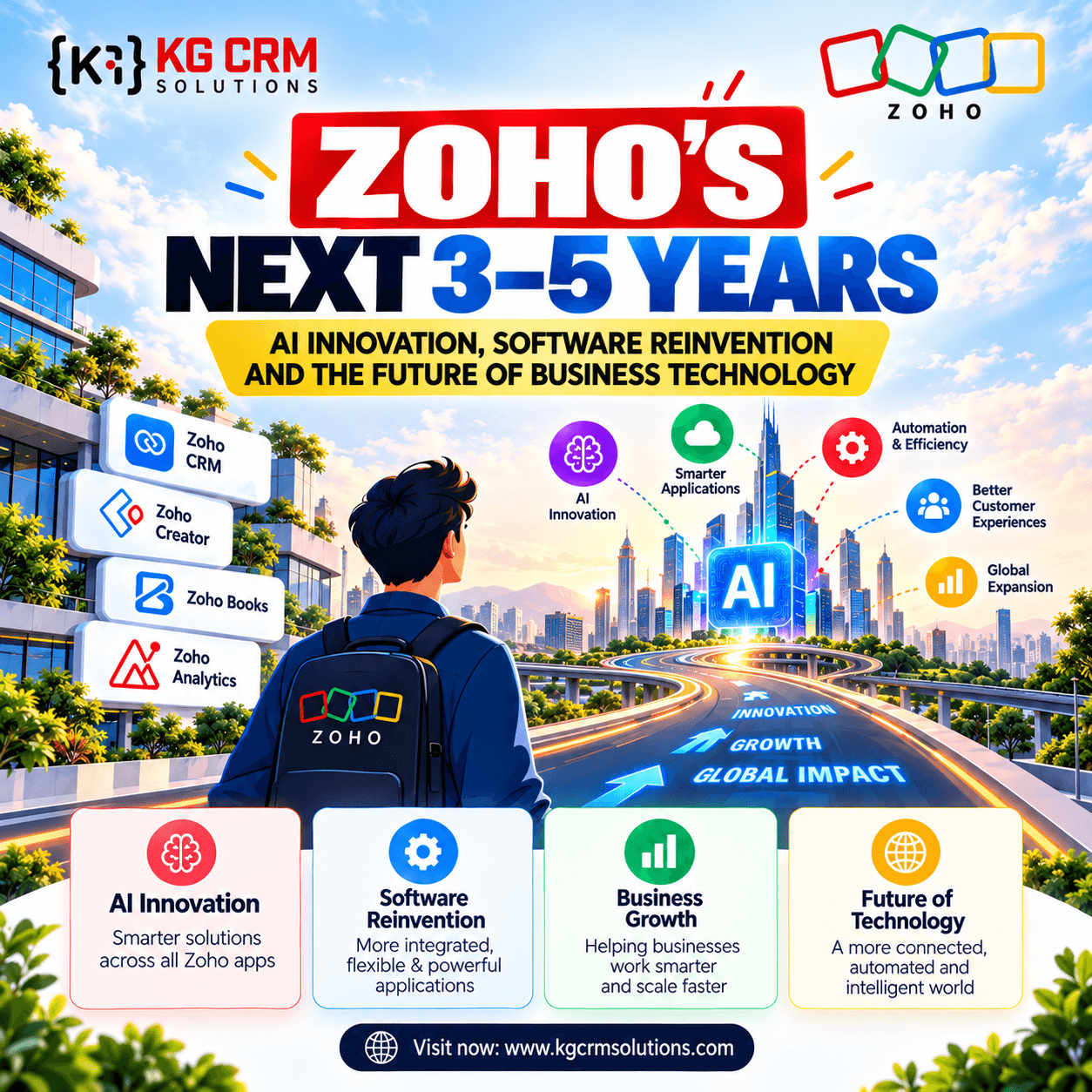
The software industry is entering a major transition. Artificial intelligence (AI) is changing how applications are developed, how employees work, and how businesses manage their daily operations. At the same time, software companies are facing rising infrastructure costs, changing customer expectations, and growing pressure to deliver more value.
Zoho is navigating this transition with a focus on AI, product development, its own technology infrastructure, and industry-specific business applications.
In October 2026, Zoho co-founder Sridhar Vembu said the company was in the middle of a reinvention process and that the next three to five years would be important in determining its outcome. He also highlighted rising server prices and AI-related costs as major challenges for the software industry.
For businesses using Zoho CRM, Zoho One, Zoho Creator, and other business applications, this period could bring important changes in how software is built, connected, and used.
Why the Next 3–5 Years Matter for Zoho
For many years, businesses selected software based on features, price, ease of use, and integration capabilities. AI is adding another layer to these decisions.
Companies increasingly want software that can understand business information, help employees complete tasks, generate insights, and automate workflows.
Zoho already offers a broad portfolio of business applications covering customer relationship management, finance, analytics, collaboration, human resources, and application development.
The challenge is no longer simply adding more features. It is making these applications more intelligent, connected, efficient, and useful for different types of businesses.
Zoho’s next phase will likely be shaped by several important areas:
- AI-powered business applications and intelligent assistants.
- AI agents that can support specific business tasks.
- Industry-specific software that requires less customization.
- Cloud infrastructure and technology cost management.
- Better integration across business applications.
- More practical ways to use business data for decision-making.
These are areas to watch rather than guaranteed predictions about future product launches.
1. AI Could Change How Businesses Use Zoho Applications
AI is moving beyond simple chat interfaces and content generation. Businesses increasingly want AI to help with actual work, such as finding information, summarizing customer interactions, identifying patterns, and supporting operational decisions.
Zoho has been developing its AI capabilities across its product portfolio. In September 2026, it announced Zia Chat, an AI interface designed to make working across business applications more convenient. The company has also expanded its focus on industry-specific software. Source: Zoho’s official press releases.
What Could This Mean for Zoho CRM?
Consider a sales team that receives dozens of inquiries every day. Employees need to review customer details, qualify leads, update CRM records, schedule follow-ups, and prepare for meetings.
AI-powered capabilities could help employees complete parts of this work faster by summarizing information, surfacing relevant records, and assisting with routine tasks.
However, the value will depend on how accurately the AI works, which actions it can perform, and how well it respects access permissions and business rules.
For companies implementing Zoho CRM, this makes proper configuration and workflow design increasingly important. AI can support a process, but the underlying data and process still need to be reliable.
2. Zoho AI Agents Could Make Business Automation More Practical
Traditional automation generally follows predefined rules. For example, when a new lead enters a CRM, the system can assign it to a sales representative and create a follow-up task.
AI agents introduce another approach. Depending on the tools and permissions available, an agent may be able to interpret a request, retrieve relevant information, and carry out a sequence of supported actions.
Zoho has already introduced AI agent capabilities, a custom agent builder, and MCP-related tools as part of its broader AI strategy.
Over the coming years, businesses may increasingly explore agents for tasks such as:
- Finding customer information across connected applications.
- Supporting sales representatives with account research.
- Preparing summaries from business records.
- Helping employees locate reports and operational information.
- Assisting with repetitive service and administrative tasks.
- Coordinating approved actions across connected systems.
These use cases will require suitable permissions, testing, monitoring, and human review for important decisions.
Why Integration Will Matter
An AI agent becomes more useful when it can access the right business information. If customer data is in Zoho CRM, invoices are in Zoho Books, and operational information is in another application, disconnected systems can limit the quality of the results.
This creates opportunities for businesses to review their Zoho integrations, data structures, and automation workflows before adopting more advanced AI features.
3. Industry-Specific Software Could Reduce Implementation Time
Another important direction is vertical SaaS, which means software designed around the needs of a particular industry.
In September 2026, Zoho announced seven industry-specific applications. The approach is intended to offer more tailored solutions for sectors with distinct operational requirements.
Why does this matter?
A general-purpose CRM can be configured for many industries, but businesses often need additional fields, workflows, integrations, reports, and approval processes to make it fit their operations.
Industry-focused applications can provide a more relevant starting point.
For example:
- Healthcare: Patient-related administrative workflows and coordination, subject to appropriate privacy and regulatory requirements.
- Real estate: Lead management, property-related processes, and customer follow-ups.
- Education: Student administration and learning-related workflows.
- Other industries: More tailored processes based on specific operational needs.
The actual capabilities depend on the relevant product and its available features.
For businesses, the potential benefit is faster implementation and less time spent designing every process from scratch. Customization will still be necessary where a company’s requirements differ from the standard solution.
4. Zoho’s Own Technology Infrastructure Could Become More Important
Cloud infrastructure is a major part of the software business. Running applications at scale requires servers, storage, networking, security, and ongoing maintenance.
The rapid growth of AI is adding pressure to infrastructure costs, including server memory and computing capacity.
Zoho has responded by investing in technology that gives it greater control over its infrastructure. In June 2026, the company announced Nathu La, a server designed in-house, with the stated aim of improving technological independence and reducing inference costs. Read Zoho’s official announcements.
This approach could help Zoho manage some infrastructure expenses and reduce reliance on external hardware vendors. However, developing and maintaining its own technology also requires substantial investment and expertise.
How Could This Affect Zoho Customers?
Infrastructure decisions can influence several aspects of a software service:
- Operating costs: Better infrastructure efficiency may help manage the cost of running applications.
- AI economics: More efficient computing can make AI features more practical to operate at scale.
- Technology control: In-house capabilities can give a provider more control over parts of its technology stack.
- Long-term planning: Infrastructure investment can support the continued development of business applications.
These are potential benefits, not a guarantee that subscription prices will fall or remain unchanged. Zoho has acknowledged cost pressures, so customers should evaluate product pricing and plan details as they evolve.
5. Zoho ERP and Its Broader Business Application Strategy
Zoho launched Zoho ERP in January 2026, adding to its broader business software portfolio.
ERP systems help organizations coordinate business functions such as finance, purchasing, inventory, operations, and reporting. For companies using multiple disconnected tools, a more integrated approach can improve visibility and reduce manual data transfer.
As Zoho continues developing its business applications, organizations may have more opportunities to connect customer management with operational and financial processes.
For example, a business could use Zoho CRM to manage leads and sales opportunities, a finance application to manage relevant transactions, and analytics tools to monitor performance.
The best setup will depend on business size, process complexity, regulatory requirements, and the capabilities of the applications selected. Businesses should assess the specific features and integration options rather than assume every process is covered by one product.
6. The Next Phase Will Also Be About Cost and Productivity
AI creates opportunities, but it also introduces new costs. Computing resources, server hardware, infrastructure, and ongoing product development can all affect a software company’s operating model.
In October 2026, Zoho’s leadership highlighted rising server prices and AI usage costs, along with a pause in employee-count growth over the previous 18 months. The company has said it is working to avoid mass layoffs while reinventing its business.
This is an important part of the story: Zoho’s next phase is not only about launching innovative products. It is also about building them sustainably.
For customers, the relevant questions include:
- Will AI features solve meaningful business problems?
- Will the features justify their cost?
- Can employees use them without complicated workflows?
- Will existing integrations continue to support business needs?
- How will pricing and product plans evolve?
The companies that benefit most from AI will not necessarily be those that use the most AI. They will be the ones that apply it effectively to real business problems.
7. What Zoho Customers Should Do Now
Businesses do not need to wait three to five years to prepare for changes in business software. They can start by reviewing their current systems and identifying where improvements would create measurable value.
Review Existing CRM Processes
Check whether leads are assigned correctly, sales stages reflect the real sales process, and follow-up activities are consistently recorded.
Improve Data Quality
Remove unnecessary duplicate records, standardize important fields, and establish clear rules for data entry. Reliable data is important for reporting, automation, and AI-supported workflows.
Identify Useful Automation Opportunities
Start with repetitive, well-defined tasks such as notifications, record updates, approval routing, and follow-up reminders. Measure whether each automation saves time or improves accuracy.
Review Integration Requirements
Identify where employees manually transfer data between applications. Consider whether native integrations, Zoho Flow, APIs, webhooks, or custom development could improve the process.
Prepare for AI Responsibly
Before enabling AI-based workflows, review permissions, data access, testing, human approval requirements, and how errors will be handled. Begin with limited, measurable use cases before expanding to more critical activities.
How KG CRM Solutions LLP Can Help Businesses Prepare
As Zoho develops its AI capabilities and business application portfolio, businesses may need help connecting these tools to their actual operations.
KG CRM Solutions LLP focuses exclusively on Zoho solutions and helps businesses with Zoho CRM implementation, customization, integration, migration, and automation.
Its services include:
- Zoho CRM consulting and implementation.
- Zoho CRM customization and development.
- API integrations and third-party connectivity.
- CRM data migration and API migration.
- Zoho Creator application development.
- Zoho Analytics and reporting.
- Business process automation.
- Ongoing support and maintenance.
For example, a company preparing for more advanced automation may first need to improve its CRM structure, connect customer data across applications, and standardize its business workflows.
A well-planned foundation can make it easier to evaluate and adopt suitable new capabilities as they become available.
Explore KG CRM Solutions LLP to learn more about its Zoho services.
Want to improve your current Zoho setup?
Schedule a Meeting to discuss your CRM implementation, integration, customization, or automation requirements.
You can also explore relevant KG CRM Solutions case studies to learn about the company’s work and service areas.
Frequently Asked Questions
What is Zoho focusing on for the next three to five years?
Zoho’s stated reinvention effort comes amid changes in AI, software economics, and infrastructure costs. Publicly announced areas to watch include AI-powered applications, industry-specific software, ERP, developer platforms, and in-house infrastructure. The exact future roadmap remains subject to change.
Is Zoho investing in artificial intelligence?
Yes. Zoho has announced AI-related products and capabilities, including Zia Chat, AI agents, and AI-enabled developer tools. Businesses should check official product announcements for current availability and feature details.
Why is Zoho developing its own server technology?
Zoho has described its in-house server initiative as a move toward greater technological control and lower AI inference costs. Its long-term impact on operating expenses and customer pricing remains to be seen.
Will AI replace Zoho CRM?
AI is more likely to change how people interact with CRM and how certain tasks are performed than to make customer management requirements disappear. Businesses will still need accurate customer data, appropriate workflows, integrations, governance, and human oversight.
How can businesses prepare for future Zoho AI features?
Businesses can begin by improving data quality, reviewing CRM workflows, identifying useful automation opportunities, and ensuring that integrations and access permissions are properly configured.
Final Thoughts
Zoho’s next three to five years could be an important period for the company and its customers. AI, industry-specific applications, ERP, developer platforms, and infrastructure investment are all relevant parts of its current direction.
At the same time, rising technology costs and uncertainty across the software industry show that innovation must be supported by a sustainable business model.
For businesses, the practical lesson is clear: build reliable processes today, keep business data organized, and adopt new technology when it delivers measurable value.
As Zoho continues to evolve, companies with well-planned CRM systems, connected applications, and effective automation will be better positioned to make use of the capabilities that fit their needs.
KG CRM Solutions LLP helps businesses implement, customize, integrate, and automate Zoho applications to support their evolving business requirements.
Visit KG CRM Solutions to explore its Zoho services.

About the Author
Parveen Kumar | Founder @ KG CRM Solutions
Parveen Kumar is the founder of KG CRM Solutions, a Zoho Authorised Partner based in Mohali, Punjab. He has been building Zoho systems for businesses across India, the UK, Australia, Canada, and the US for over 8 years, specialising in Zoho CRM, Zoho Creator, Deluge scripting, custom integrations, and widget development.